
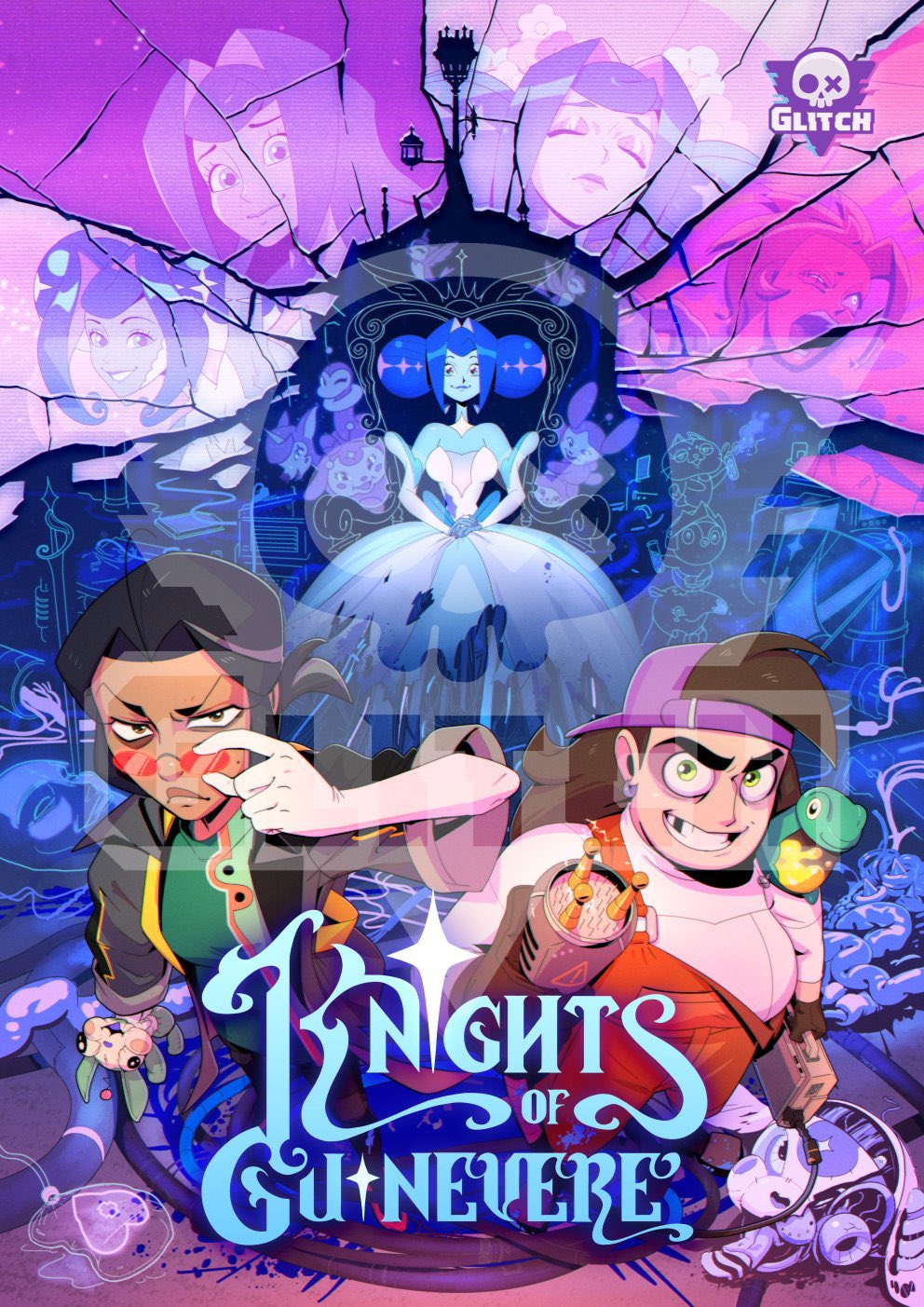
A show that stopped pulling punches.
Last time I wrote here, I admitted to being a snob about a colorful YouTube cartoon about clowns — and to being thoroughly, embarrassingly wrong. Somewhere in the middle of that binge I also caught the pilot of Knights of Guinevere, the show I’d mentioned in passing as taking aim at the House of Mouse. I liked it a lot. But with what the circus had just done to my head, I shelved it as a good memory: a gorgeous, eerie half hour of sci-fi fairy tale with some bite. Fine. I figured I knew what I’d be getting if it ever came back.
I didn’t. Earlier this month the second episode, “Wolves Around the Corner,” finally dropped, and somewhere around the midpoint I realized the pilot had just been the show being polite. Drugs. Abuse. Police violence. Androids treated as property. And blood — and the camera doesn’t cut away from that, either. Was it worth over a year of waiting? Absolutely. Was it fun? Depends on your appetite. If trauma as a plot engine is your kind of comfort food — then yes. Guilty as charged.
For the uninitiated, a quick setup. Far future. Somewhere above the clouds floats Park Planet — an amusement park the size of, well, a planet, all bright, iridescent color, with an android princess named Guinevere as its smiling mascot. Below it, in the grime and scrap, lives everyone who keeps the magic running. Two of them are Andi, an android surgeon who until recently was on the park’s payroll, and Frankie, a factory worker who fishes junk out of the scrapyards on the side. Both overworked, both broke, both tired. Then Frankie hauls a busted Guinevere out of the scrap, and the two of them decide to fix her — which, this being a psychological thriller, you just know is going to cost them. And if a magical kingdom built on the backs of exhausted workers rings a bell… hold that thought.
So, about that bell. The person behind Knights of Guinevere is Dana Terrace — you might know her as the creator of The Owl House, a Disney Channel show that was doing just fine, thank you, until someone upstairs decided it didn’t fit the brand. Its run got cut short, and Terrace eventually walked out of the House of Mouse altogether. Then came a message from Glitch’s CEO, Kevin Lerdwichagul, with a pitch that must have sounded almost suspicious after years of studio notes: do you want to make whatever you want? She did. And what she wanted to make, as it turns out, was a story about a giant corporate theme park, its forever-smiling princess mascot, and the people grinding themselves down beneath it. Subtle? Not even a little. But reading it as a breakup letter to Disney with a sci-fi coat of paint would sell it short — Terrace made it clear early on that anyone expecting “Owl House 2.0″ was in for a surprise, and that this one was meant for grown-ups. Episode two is where that warning stops being a footnote.
From here on — spoilers, and a content warning to go with them: violence and gore, drugs, abuse, police brutality, sexualization, and body horror of the mechanical kind. If you haven’t seen the episode yet, go ahead. I’ll wait.
The episode picks up right where the pilot left off. Andi and Frankie haul the android — now nicknamed Gwen — to Krash, an old friend of Andi’s who patches people up in Sparky’s underground chop shop. Not exactly a clinic. And this is where the screws start turning: an argument between the girls about Sparky, and the way he treats the people around him, sends Gwen spiraling into a flashback of something she very clearly never wanted to remember. She bolts — into a nightclub, and straight into the arms of a man who’s been looking for her. A Park Planet officer. She hurts him badly enough that Andi and Frankie end up tending to him, and Andi, it turns out, knows exactly where the drugs are stashed and doesn’t hesitate for a second before reaching for them. The show doesn’t linger on it, so I won’t either. But I noticed. From there it escalates fast. Frankie gets hurt, the officer doesn’t walk away, and Gwen does — wearing his mechanical arm as her own. Let that image sit for a second: the park’s fairy-tale princess, patching herself up with a piece of the park’s enforcer.
And that arm is where the episode’s real horror lives — not in the blood, but in the bookkeeping. Think about it for a minute. In a world where androids are everywhere, what is “salvage” if not organ harvesting with better PR? Frankie fishing broken machines out of the scrap, Sparky’s chop shop stripping them for parts, Gwen grafting a dead man’s arm onto herself — it’s all the same economy, just seen from different floors of the building. Bodies in, parts out. The pilot set this up quietly; episode two rubs your face in it. Some viewers went a step further and read the Guinevere androids as being sold for something considerably less wholesome than photo ops with kids. I’ll be honest: I didn’t see it that way while watching. Then again, I sit at a firm zero on the fandom thirst scale, so I’m probably the last person who’d pick up on it. And knowing what the show is aiming at — a company that turns a princess into a product — I can’t say the reading is unfair.
Which brings me to the characters — and to Gwen first, because she walks away with the episode, and not only with that arm. After a pilot she spent mostly switched off, she’s finally awake, and she’s a lot: funny in an awkward, uncanny way one moment, terrifying the next, haunted by memories she understands about as well as we do. Eden Riegel gets far more to work with this time, and it shows. And then there’s the rooftop, where Andi and Frankie realize their broken princess isn’t just a Guinevere — she’s the Guinevere, the original, the very same android they met as kids sneaking into the park. So much for a convenient piece of salvage. The girls themselves are still the heart of the show: two worn-out women who are each other’s whole support system. Part of the fandom reads more into that, and with the right lighting, sure, I can see it. Personally, I couldn’t care less what we call it — it works either way.
Around them, the cast keeps growing, and not in a cozy direction. Sparky, Frankie’s boss, is grumpy and cold — no smiles, no warmth — but read between his lines and Frankie clearly matters to him. The trouble is how that shows: the way some people care at home, behind closed doors, where concern and control are the same gesture. Andi gets none of it. During one argument she nearly falls, and he catches her — by the broken arm. Then, while he finishes making his point, he squeezes. Hard. Andi winces, and the show lets you sit in that moment. Then there’s Krash, Andi’s old friend turned back-alley doctor, who makes it plain he won’t cover for them once Sparky finds out — which tells you everything about who holds the leash down there. Patience, a holographic AI in Olivia Park’s service. And Olivia herself — the founder’s daughter, old, bedridden, and by all signs the real threat here — barely shows up this time. Which, honestly, makes her scarier, not less.
What I didn’t expect was how much bigger the world got in a single episode. The pilot gave us the postcard: Park Planet glittering up top in bright, iridescent color, M7 and the scrapyards down below in rust and grime, and the gap between them doing most of the talking. If that setup feels familiar, it should — I couldn’t shake the feeling of Piltover and Zaun from Arcane. A shiny city of progress on top, an undercity paying for it underneath, and everyone on both levels pretending not to know. Episode two takes the stairs down. Chop shops, nightclubs, back rooms, people who clearly have their own stories going on just outside the frame. You start to get a feel for how this society actually runs — who works for whom, who’s afraid of whom, and how little a life — flesh or metal — is worth down there. The soundtrack deserves a word too: it’s poignant without ever getting loud about it, never shoving itself in front of the scene, and somehow that’s exactly why I noticed it. And for the properly obsessed: the episode hides a QR code leading to a page on parkplanet.net, so yes, there’s lore living outside the show. I haven’t gone down that rabbit hole yet. Yet.
So where does it go from here? Not as far as I’d like, at least on paper — the season is set at eight episodes, with episode three due in January and the fourth sometime in spring. At that pace, we’re in for a long, slow ride. Eight half-hours isn’t a lot of room. And yet, look at what’s already on the table. Andi promised Sparky he’d get Gwen once she was fixed — a promise that looks a lot worse now that they know who she really is. Then there’s the officer. The girls drag him back to Krash still hoping he can be saved, and Krash’s answer lands like a fist to the stomach: he’s gone. What they do with him afterwards, we don’t know. What we do know is that a Park Planet officer is dead, the park is still looking for Gwen, and two tired women from M7 are now very much part of the story. Olivia is lurking somewhere above it all, and I doubt she’s done. And Gwen herself is a walking mystery — her past, her memories, whatever it was she ran from all those years ago. If the pilot proved anything, it’s that this team can pack an absurd amount into twenty-odd minutes. If episode two proved anything, it’s that they’re not going to waste any of it on being nice.
Back to that rooftop, then. Years ago, two kids snuck into a magical kingdom in the clouds and met a princess. Now that princess has found her way back to them — broken, half-salvaged, wearing a dead man’s arm, and nothing like the fairy tale either of them remembered. That’s the whole show in one image, really: the dream doesn’t come true, it comes back, and it wants something from you. Where Terrace and company take it from here, I honestly don’t know, and I won’t pretend otherwise. But I did learn my lesson last time. When something under a colorful coat of paint keeps telling me it has teeth, I listen. So this time I’m keeping my eyes peeled — and January can’t come soon enough. If any of you have already watched it and found an even darker reading than mine (somehow), drop it in the comments. I’m genuinely curious. And just a little bit afraid.